Bazaar is the word for a market or a fundraising sale. Bizarre is an adjective for something very odd. If you are describing a place with shops or stalls, bazaar is usually the word you want. If you are describing a strange situation, choose bizarre. The similar sound can be misleading, but the words do different jobs in a sentence.

The difference at a glance
| Word | Job in a sentence | Meaning | Example |
|---|---|---|---|
| bazaar | Noun | A market; also a sale raising funds | We met at the bazaar. |
| bizarre | Adjective | Very odd or unexpected | That was a bizarre coincidence. |
A noun can name the place you visit. An adjective can describe an object, event or experience. A market is not automatically strange, and an unusual experience does not have to involve shopping.
Use bazaar when you mean the market
Cambridge Dictionary includes both a shopping-place sense and a fundraising-event sense. That explains why you might read about a bazaar in a historic city centre or see the same word on a school-sale notice. The wider context tells you which meaning is intended.
- We looked for a scarf at the bazaar.
- The neighbourhood bazaar has several independent stalls.
- Our school is organising a bazaar to support its library.
These are illustrative sentences, not claims about a particular market. For more context on the market word itself, read what a bazaar is and how it differs from a market. That broader guide covers the shopping concept; this page concentrates on the spelling choice.
Use bizarre when you mean something odd
Bizarre describes a quality. It can appear before the thing being described or after a linking verb such as seem. In the examples below it describes an announcement, a coincidence or a story, rather than naming a place to shop.
- The announcement took a bizarre turn.
- It seemed bizarre that we had chosen the same scarf.
- She told a bizarre story about a missing suitcase.
You could describe an experience at a market as bizarre, but that is an opinion about the experience. It does not change the spelling of the market’s name. Keep the judgement and the place name separate when writing a travel note.
A spelling check that does not depend on pronunciation
Write the market word as b-a-z-a-a-r: it has a double a. Write the describing word as b-i-z-a-r-r-e: it has a double r and finishes with e. Bazaar becomes bazaars in the plural; adding s does not turn bizarre into the name of several markets.
Pronunciation can vary by accent, so sound alone is an unreliable editing check. The dictionary references below include pronunciation guidance. For writing, try a substitution: would market fit what you mean, or would odd fit? This is a practical meaning check, not a rule for translating every proper name.
Common mistakes and how to correct them
- I bought it at the bizarre. If you mean a market, change the final word to bazaar.
- It was a bazaar coincidence. If you mean an odd coincidence, choose bizarre.
- A bizarre bazaar. This can be grammatical: bizarre describes the bazaar. It deliberately uses both meanings.
Spellcheck may accept either word because both are valid English. Read the whole sentence before changing it. If you are reproducing the name of a shop, publication or event, check that organisation’s own spelling instead of automatically correcting a brand name.
Try four short practice sentences
- We bought a notebook at the ___.
- The clock made a ___ noise.
- The charity ___ will raise funds for new books.
- The explanation sounded ___.
Answers
1: bazaar. 2: bizarre. 3: bazaar. 4: bizarre. The first and third sentences name a sale or shopping place; the other two describe something odd.
If you can explain why a word fits, you are less likely to swap it just because it sounds familiar. Keep this distinction in mind when writing a market review, a school invitation or a message about a trip.
Connect the word with a real bazaar
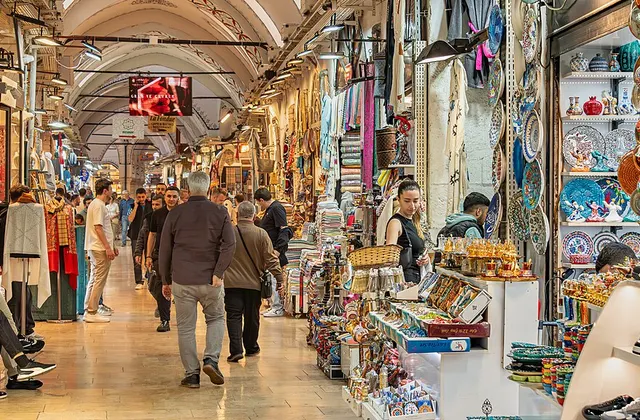
The licensed photograph above shows Istanbul’s Grand Bazaar in May 2025. It illustrates the market sense of bazaar; it is not evidence of the shops or displays you will find today. Our Grand Bazaar visiting guide deals with the separate practical questions of hours, entrances and transport.
For another market word, see what a flea market is. To find actual places rather than definitions, open the city guides and check each venue’s source and trading day.
Sources and editorial method
Dictionary and university usage references consulted on 25 October 2026. The explanations, example sentences and practice questions are written by BazaarFinder; they are not quotations or reports of a first-hand visit.