A flea market is a market associated with second-hand goods, where separate sellers offer things such as used clothing, household objects or collectibles. The name describes a type of shopping place, not a guarantee that every item is old, inexpensive or an antique. To plan a visit, look beyond the label: check the venue, the trading day and what its sellers actually offer.

Flea market meaning in everyday English
Cambridge and Merriam-Webster describe a flea market in terms of used goods and the market format. Many are associated with outdoor selling, but the label alone does not tell you whether a particular site has a roof, permanent shops or temporary stalls. Read the venue’s own description before making a weather-dependent plan.
As an original example sentence: We spent Saturday looking for second-hand books at the flea market. The sentence tells you the kind of market; it does not establish that every flea market sells books or operates on Saturday.
Why is it called a flea market?
The name is commonly linked with the French expression marché aux puces, literally a market of fleas. Merriam-Webster’s word-history discussion treats the precise origin as uncertain and considers competing explanations. It notes historical use connected with second-hand markets in both Paris and Copenhagen.
A neat origin story is therefore best presented as an explanation under discussion, rather than a proven event involving one named visitor. In modern use, flea market identifies the kind of market. It is not a report that a particular venue or its goods have insects.
What can you find at a flea market?
The assortment belongs to the individual venue and its sellers. As a concrete example, Encants Barcelona’s operator describes a mix that includes vintage fashion and decoration, antiques, new products and outlet goods. That is a reminder to check the seller and the item rather than assuming every object is second-hand.
For a book, check the edition, condition and missing pages. For clothing, inspect measurements, seams and care information. For a household object, ask what parts or accessories are included. Terms such as vintage, handmade or collectible need context; the label on a market does not authenticate the age, materials or origin of everything sold there.
Flea market, bazaar or swap meet?
| Term | Main idea | What to check |
|---|---|---|
| Flea market | Second-hand goods and multiple sellers | Actual stock, venue and trading sessions |
| Bazaar | A market or shopping area; also a fundraising sale | The local meaning and organiser |
| Swap meet | A gathering to sell or exchange possessions | Whether buying, exchanging or both take place |
These terms can overlap in practice. Cambridge marks swap meet as a US term and includes selling as well as exchanging. Do not assume that a swap meet requires you to bring something to trade. For the broader market word, read our bazaar meaning and bazaar-versus-market guide.
Are flea markets always cheap?
No market name is a price guarantee. Compare the exact item, its condition and what is included. A damaged object can cost more overall if it needs repairs or difficult transport, while a well-presented collectible may have a specialist asking price. Decide what an item is worth to you before you start negotiating.
Ask whether the price is fixed and which payment methods the seller accepts. If bargaining is welcome, keep it polite; there is no universal discount to expect. Confirm the total, currency, receipt and any delivery or return arrangements before paying. A statement about one stall’s terms should not be applied to the whole market.
Check the trading day before the journey
Separate the name of the site from the session you want. A market building can contain different activities, and a food stall, antiques section or special event may use its own timetable. Holiday notices can also change an ordinary pattern. Follow the operator’s current calendar for the activity and date rather than treating a map label as a live opening report.
Make one main stop and keep another optional. Bring measurements if you want an object for a particular space, and consider packaging and the journey home. An attractive piece of furniture is only useful if you have a realistic way to collect it. You can browse without buying; finding nothing suitable is a valid outcome.
A real example: Encants Barcelona
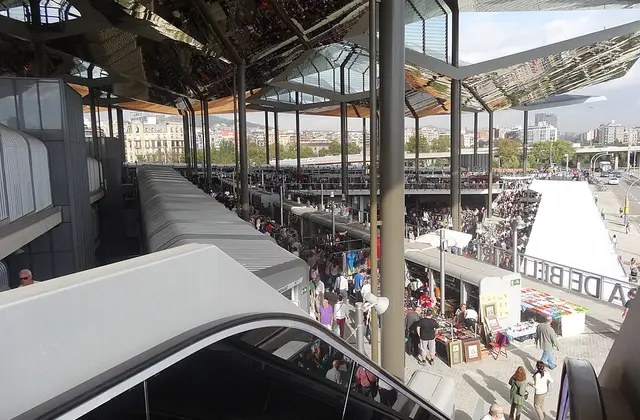
The archive photograph above shows Encants in Barcelona in October 2013. Barcelona’s official tourism description presents the market beneath a large mirrored canopy, arranged on different levels and connected to the outdoor environment. It illustrates why the simple distinction between indoor shop and open-air stall may not describe a venue very well.
For a practical plan, use our Encants days and visiting guide and its individual market record. The photograph helps identify the venue; it cannot establish current stall positions or attendance. The Barcelona city guide also distinguishes flea-market visits from food halls and Sunday books.
A few common questions
Is a flea market the same as an antiques market?
The names overlap, but do not assume every flea-market item is an antique. Check the particular seller’s description and evidence for an object’s age. A marketplace category is not authentication.
Do I need to bargain?
Ask the seller whether the price is negotiable. A market label does not oblige either side to bargain, and a polite browse can end without a purchase.
Does a flea market only sell used goods?
Check the venue. The Encants operator, for example, lists new and outlet goods alongside vintage and antique categories.
Where can I find one?
Start with the flea and vintage market directory, then check the individual location, available hours and source. Coverage varies. If you are still choosing a destination, browse the city guides.
Sources and editorial method
Dictionary, word-history and market-operator references consulted on 25 October 2026. This is an introductory explanation with original planning advice, not a report of a first-hand visit. Check a particular market’s current operator notices before travelling.
- Cambridge Dictionary: flea market
- Merriam-Webster: flea market definition
- Merriam-Webster: competing explanations of the name flea market
- Cambridge Dictionary: swap meet
- Cambridge Dictionary: bazaar and fundraising sense
- Encants operator: actual mix of sellers and goods
- Barcelona official tourism: Encants venue and covered structure